
BLP Conversations: Stephen O'Connor & Suki Kim
In this excerpt from their conversation, Stephen O’Connor, professor at Sarah Lawrence College and author of We Want So Much to Be Ourselves, and Suki Kim, investigative journalist and author of Without You, There Is No Us, discuss historical accuracy, moral complexity, and how people cope with life under totalitarian regimes. This conversation is part of the BLP Conversations series from Bellevue Literary Press, featuring dialogues that explore the creative territory at the intersection of the arts and sciences. The whole conversation can be viewed here.
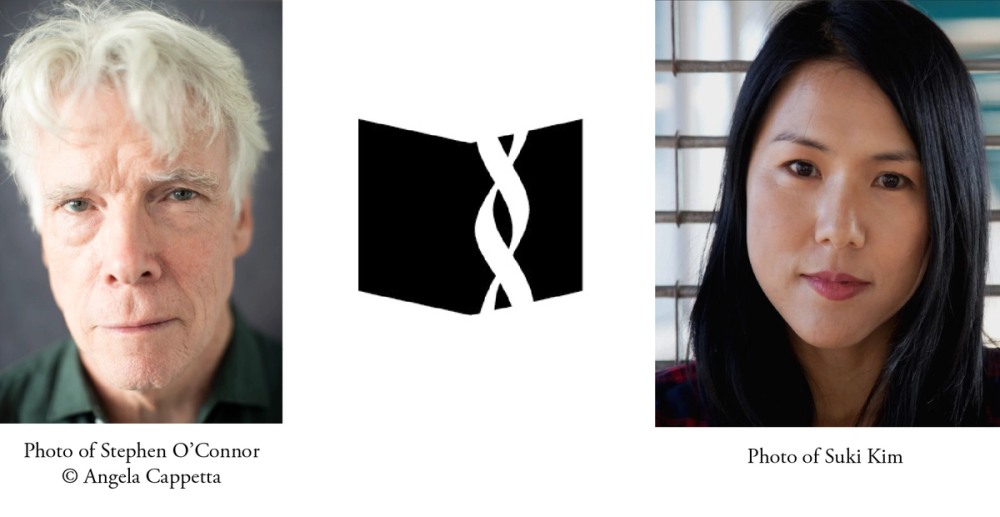
Stephen O’Connor: Why did you choose to write your latest book as nonfiction rather than as a novel, since you’re also a novelist?
Suki Kim: I witnessed what was happening in North Korea on my first trip in 2002 for the New York Review of Books, and it was clear to me that no amount of fiction could describe the horror that was unfolding in the contemporary world. At the time I was solely a fiction writer, so it was a choice to cover it as narrative nonfiction. I felt very strongly that this had to be nonfiction, so everyone would know that none of this was made up. Writing the book ended up taking ten years. But what about for you? You think it’s a choice you made because you write in both genres.
SO: I made exactly the same choices as you with my two nonfiction books. One of them is about when I was teaching creative writing in the New York City public school system. I was writing, like you, about my students, and even though it’s called a memoir, I think it’s actually a portrait of them and an investigation of certain injustices in American society. My other nonfiction book was about the beginnings of foster care and child welfare in America, and in both cases, I wanted to be sure my readers believed my every word.
We Want So Much to Be Ourselves is a novel, I think, partly just because of how I was inspired to write it. I was on my way to Yaddo and had just finished another novel, 600 pages long, which took me six years, so I wanted to write short stories. Suddenly, a story popped into my head that had been told to me by a former student from back in the ‘70s in Berkeley. She was a German Jew, born in Berlin. She was on a dock in Italy on her way to Palestine sometime in the 1930s with her mother, and her mother suddenly said, “No, I can’t go. I’m German. I have to go back.” So her mother returned to Berlin, where she was murdered by the Nazis, and my student went on to Palestine.
That’s a shocking story, but it felt too formulaic, too familiar, so I almost gave it up. But then two things happened in my head. One was that I told myself that if I wrote this story, the father of the girl would be a psychoanalyst. The other was that everybody in the story would believe that they are right, but they’re all going to be wrong.
It was that paradox of well-intentioned people being wrong that inspired me. I’m always very interested in when two things are true simultaneously. A philosophical concept inspired this novel, whereas the previous nonfiction books had all been about very clear political issues.
SK: I think it’s inspiration that is, ultimately, what makes one write a whole book on a topic. In this case, it’s incredibly difficult, and in some cases it’s impossible. Nazi Germany, psychoanalysis, Hitler, and the Third Reich—I think these are such loaded things to approach. Only when you decide to write a book and follow this impossible path for so long, that moment of inspiration becomes why you do it.
All my life, prior to my trip in 2002, I’d heard a story of North Korea, of what had happened, because my uncle disappeared in North Korea, and the family got separated. But there was no other way of explaining what I was seeing, this world of the Great Leader, unless generations had gotten wiped out. That story never got told, because no one escaped to tell it. The world was not interested, and without any evidence, how could I tell this story?
That moment of inspiration made me think this book was not going to be fiction. Although I was a fiction writer, I felt like I would let them get away with murder if anything was made up, whereas if I could somehow come with evidence and explain what was happening, then the world would start paying attention. That was the only way I could do the book, right? This book took a long time.
SO: I’m struck by how your inspiration for writing your book was so like mine. I wanted, with my two nonfiction books, to have an effect on the world, to help the students that I was teaching, and people like them. I wanted to do the same with Orphan Trains, my book about the origin of child welfare and foster care. I hoped it might help improve the ways poor and vulnerable children are treated today. So I had a political ambition for both of these nonfiction books. I also truly decided to write them. I didn’t really decide to write this novel. The story just seized control of my brain while I was driving, and by the time I got to Yaddo, I said, “Oh my god, I’m working on another novel.”
Everybody knows that Nazi Germany was horrible. My ambitions were not so much to redocument a story that’s already well known. What I wanted to do instead was, within the context of that story, encourage people to think about that era in ways they hadn’t before. I also wanted them to consider issues that they hadn’t thought about before. Also, of course, I simply wanted to tell a good story, one that would engage and move my readers.
I started writing this novel before Trump won his first election, so I had no idea then how topical the story I had in mind would turn out to be, or how political. That simply was not my intention. I was much more interested in various moral paradoxes and in the complexity of my characters. I was especially interested in the ways in which people in Germany had to lie themselves in order to live. On one level, they knew that something terrible was being done in their name, and on another level they just couldn’t bear to know it. Like everybody else, they wanted simply to go on with their lives, keep their jobs, play with their kids, fall in love, play sports. And if they allowed themselves to know how terrible what was actually going on in their country actually was, everything that mattered to them would seem trivial.
SK: It’s double think, believing two things at the same time, which we do all the time.
SO: Yeah. T.S. Eliot said that “humankind / Cannot bear very much reality.” It’s true—we lie to ourselves all the time. I mean, we’re all going to die. How often do we think about that? Not very often. We do all kinds of things that might kill us: we go skiing, we go hang gliding, but we don’t think that we’re going to die. We mostly pretend that, somehow, we’re immortal, that we’re going to be here forever. There are all kinds of other ways in which we’re constantly lying to ourselves or constantly not thinking about things.
Within ordinary society, in a time that’s not politically charged, such self-deception doesn’t really matter. But in Nazi Germany, the only way you could get out with the moral dimension of your soul intact would be to be willing to die. Because, if you had opposed Hitler, he would kill you. And the same is true in North Korea. The most trivial things can get people killed there. So everybody is afraid, and everybody is lying to themselves all the time, just so they didn’t have to feel compelled to oppose the government. So in Germany, people simply didn’t want to interpret Hitler’s rhetoric in a way that would make what he was actually doing clear. And they dismissed what they called “rumors from the East”—that is: about the death camps. They’d say, oh, that’s just exaggeration, in the same way we dismiss conspiracy theories.
SK: How else would you be able to live there? I always found it really interesting that people would sometimes, after my book came out, ask me, “Is it as bad as we think it is?” What do you think? You know, the entire country is not allowed to leave, and no one’s allowed to come, unless something awful is happening. Who has that kind of block against the world unless there’s a terrible secret to hide? The system of the Great Leader is not possible unless you are an absolute dictator and you shut down everything, so in a way it’s very obvious. But we don’t want to believe, right? It’s so obvious what’s happening there, and yet we don’t want to believe, because if it’s as awful as we fear it might be, then we are complicit by ignoring it. So I think it goes back to our own survival. We don’t want to be guilty, so we don’t want to believe it. Although the evidence is there in front of your eyes, you’d rather not see it. I think it’s complicity that makes all of these things possible. Not to simplify it, but there is this sort of double think where you are a good person and yet you can ignore murder happening in front of you all the time.
SO: I was so interested in your book when the students are just convinced that their country is the envy of the world—that they’ve invented everything, that life is better there, everything that they do there is better than any place else on earth—and yet you could see from the way they behaved and their fascination with your life in New York, with South Korean and American film, and so forth, that they weren’t sure. They would drive through the same areas that you drove through, where there’s incredible poverty, but they wanted not just to excuse their inaction, but to believe they’re leading a good life.
I always tell my students that, as a writer, your biggest enemy is your defense mechanisms. The two main defense mechanisms we all have are: one, we want to believe that we are better than we actually are; and, two, we want to believe that we are safer than we actually are. You have to fight those desires, and any other impulse to distort reality, so that you can render the world to your readers as it actually is, and enable them to become just a little wiser. It’s hard to surrender your defense mechanisms. It means admitting vulnerability, it means admitting weakness and, maybe, your own immorality.
SK: I think that humanity means responsibility, right? You don’t want to accept what is happening, so you accept lies, willingly. That’s what you show in your novel, really brilliantly, of this self-deception, deception of the nation, lies that you start telling yourself and the country starts telling each other, and then it normalizes.
I think this process is a quite a familiar one at this point, and North Korea is a successful example of that, wiping out any thinking person or any moral person. I was so struck by the fact that an entire generation must have gotten wiped out, because for this country to exist now, almost 80 years later, means everyone who’s thinking, anyone who’s decently caring about other human beings and justice and truth, those have all been killed, for this to continue for this long.
SO: The hardest part of my research was when I went to Auschwitz-Birkenau. There was one point where I was standing on the plain in Birkenau—big, flat, just goes on forever, wind is blowing, you know, it’s the familiar images we’ve seen in zillions of photographs—but I was looking at the ruins of the crematory and the gas chambers. One of them had been destroyed by some of the inmates in an incredibly brave rebellion, but most of them were destroyed by the Nazis themselves. I thought, well, what that means is that they knew that what they were doing was unforgivable. The Russians were about to arrive, and they didn’t want the Russians to know what they were doing, and yet they kept on doing it.
Not only were they murdering people there, but they were murdering themselves, they were committing moral suicide, they were destroying the humanity in themselves. That was utterly horrifying to me. And now I am thinking that, in a way, it applies to what’s gone on in North Korea, and it adds another horrible dimension to it. Everybody who’s going along with these patently untrue beliefs that they’re encouraged to believe is committing a kind of suicide.
Stephen O’Connor is the author of seven books including two novels, Thomas Jefferson Dreams of Sally Hemings and We Want So Much to Be Ourselves, and the short story collection Here Comes Another Lesson. His fiction has appeared in the New Yorker, Harper’s Magazine, and Best American Short Stories, among other publications, and his nonfiction has been published in the New York Times, Nation, Boston Globe, and elsewhere. He teaches fiction and nonfiction writing at Sarah Lawrence College and lives in Manhattan.
Suki Kim is a South Korea–born investigative journalist and a novelist and the only writer to have lived undercover in North Korea for immersive journalism. Kim’s New York Times bestseller Without You, There Is No Us: Undercover Among the Sons of North Korea’s Elite is an unprecedented literary documentation of the world’s most secretive gulag nation. She was the 2023–2024 Keith Haring Chair of Art and Activism at Bard College.